


Quality
At Apogee Semiconductor, quality is engineered into every stage of development, from architecture and design through manufacturing and long-term product support.
Design & Change Control
Structured design reviews, verification planning, and formal change control processes ensure product integrity from concept through production.
Manufacturing & Supplier Oversight
Apogee works with qualified foundry, assembly, and test partners and maintains oversight through documented processes, traceability, and supplier performance monitoring.
Reliability & Qualification
Products are evaluated through defined qualification flows and reliability assessment to support robust operation across expected environmental and electrical conditions.
Continuous Improvement
Quality metrics, corrective action processes, and engineering feedback loops enable continuous improvement in both design and manufacturing processes.
key pillars of Apogee’s quality approach
Product shelf life
 The product shelf life for semiconductor products after delivery to a customer is based on factors such as the type of materials used in the device, manufacturing conditions, moisture sensitivity level (MSL), the use of moisture barrier bags (MBBs) in product packaging, the amount of desiccant used and the customer’s storage conditions. Apogee carefully controls its internal manufacturing and storage processes to deliver products with appropriate customer shelf life performance.
Apogee product storage
We encourage customers to take these details into account when managing and assessing Apogee product storage and life span.
The minimum useful life of a Apogee product is based on the date of delivery to the customer, not the manufacturing date.
Apogee conducts extensive, long-term reliability studies to confirm its internal manufacturing shelf life policy. The studies “Shelf-Life Evaluation of Lead-Free Component Finishes,” “Component Reliability After Long Term Storage”, “BGA Package Component Reliability After Long-Term Storage” and “Long Term Storage Evaluation of Semiconductor Devices” confirmed that there is no degradation of a product’s electrical characteristics and no product failures associated with TI’s internal manufacturing storage practices. Additionally, Apogee takes specific actions in its product distribution centers to ensure the integrity of all material before shipment.
Because of advancements in technology, materials, manufacturing methods and logistics, Apogee’s manufacturing date code has no impact on usage, quality or reliability of products.
In summary, the minimum useful life of a Apogee product and the Apogee warranty period begins following the delivery of the product to the customer. For more information, refer to our terms of sale.
Customer product shelf life
How customers store Apogee products is critical. Customer product shelf life refers to the length of time that a customer can properly store a product after delivery. The way that our customers store and handle Apogee products is critical to ensuring that the products meet their expected customer shelf life. Please see the MSL information on Apogee product bags or boxes for instructions regarding the acceptable length of environmental exposure. Note that certain products are moisture-sensitive and therefore require packing in MBBs. We use dedicated MBBs and a defined quantity of desiccant that allows storage within this MBB. Apogee also includes humidity indicator cards (HIC) within its MBBs to ensure that product storage has not been compromised. If the HIC shows pink on >10% level, then the parts in that MBB will need baking before use.
Apogee’s policies and practices help ensure quality, reliability, and continuity of supply. Building, managing and holding inventory in a way that helps ensure continuity of supply to customers provides more immediate availability of products and helps minimize burdens caused by production constraints and end-of-life complications on mature products. Apogee’s policies help ensure continuity of supply. We build, manage and hold inventory in a way that helps ensure continuity of supply to customers. This provides more immediate availability of products, and helps minimize burdens caused by production constraints and end-of-life complications on mature products.
Product Shelf Life and Moisture Sensitivity
Apogee Semiconductor is committed to delivering components that meet the highest standards of reliability and manufacturability. This page outlines our product shelf life policies and moisture sensitivity level (MSL) classifications, in accordance with JEDEC standards.
Moisture Sensitivity Level (MSL) Classification
Apogee Semiconductor characterizes its products for moisture sensitivity in accordance with JEDEC J-STD-020, the industry-standard specification for moisture/reflow sensitivity classification of nonhermetic solid-state surface mount devices.
MSL characterization is performed empirically — each product family undergoes controlled moisture soak and reflow stress testing to determine its classification.
MSL Ratings Table
| MSL Level | Floor Life (at ≤30°C / 60% RH) | Notes |
| MSL 1 | Unlimited | No dry pack required |
| MSL 2 | 1 year | - |
| MSL 2a | 4 weeks | - |
| MSL 3 | 168 hours | - |
| MSL 4 | 72 hours | - |
| MSL 5 | 48 hours | - |
| MSL 5a | 24 hours | - |
| MSL 6 | TOL (Time on Label) | Mandatory dry pack |
Note: The majority of Apogee Semiconductor products are currently characterized at MSL 1, meaning they carry an unlimited floor life under standard ambient conditions and require no special dry pack or moisture barrier bag (MBB) packaging.
Screening and Lot Acceptance Flows
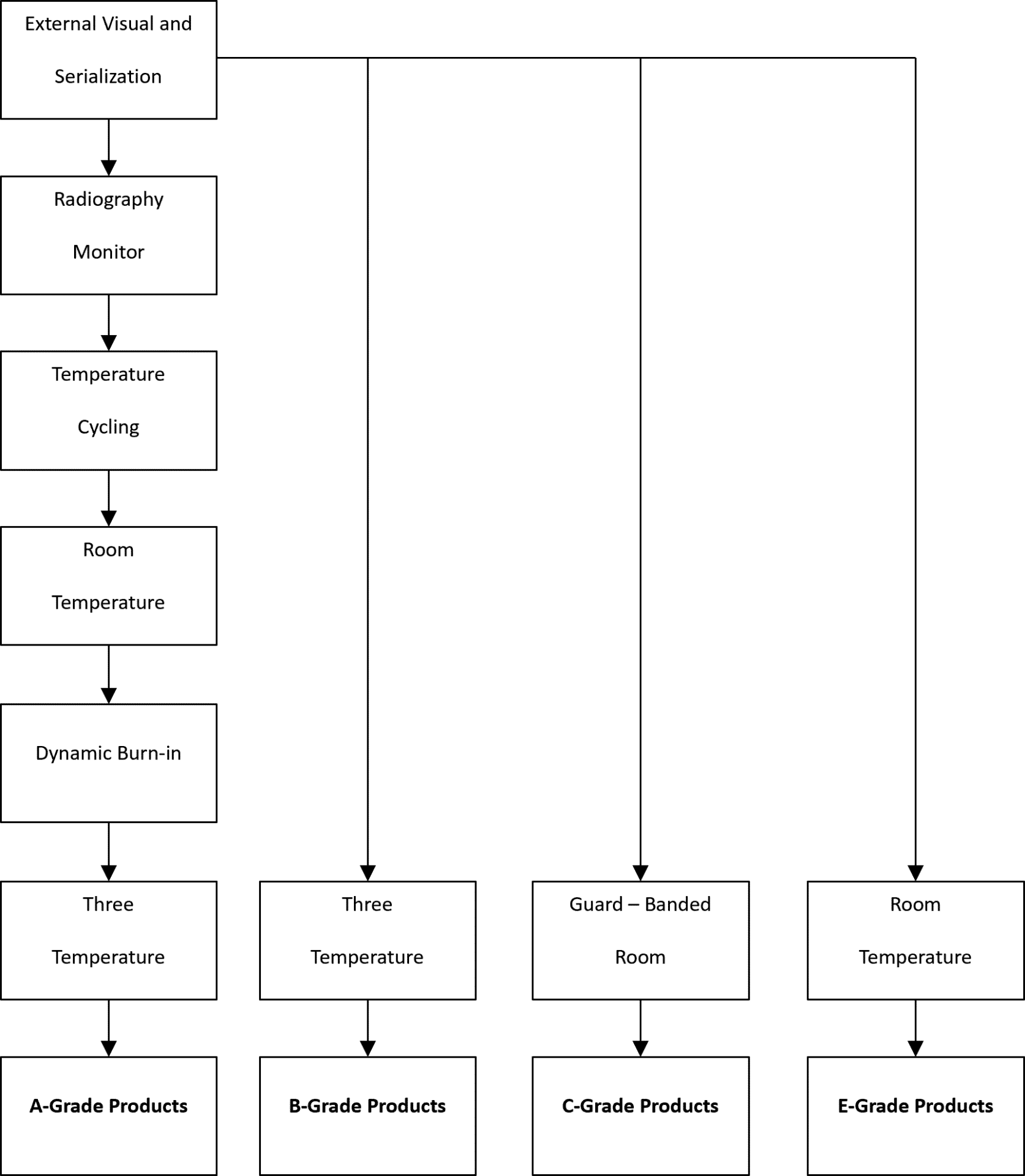
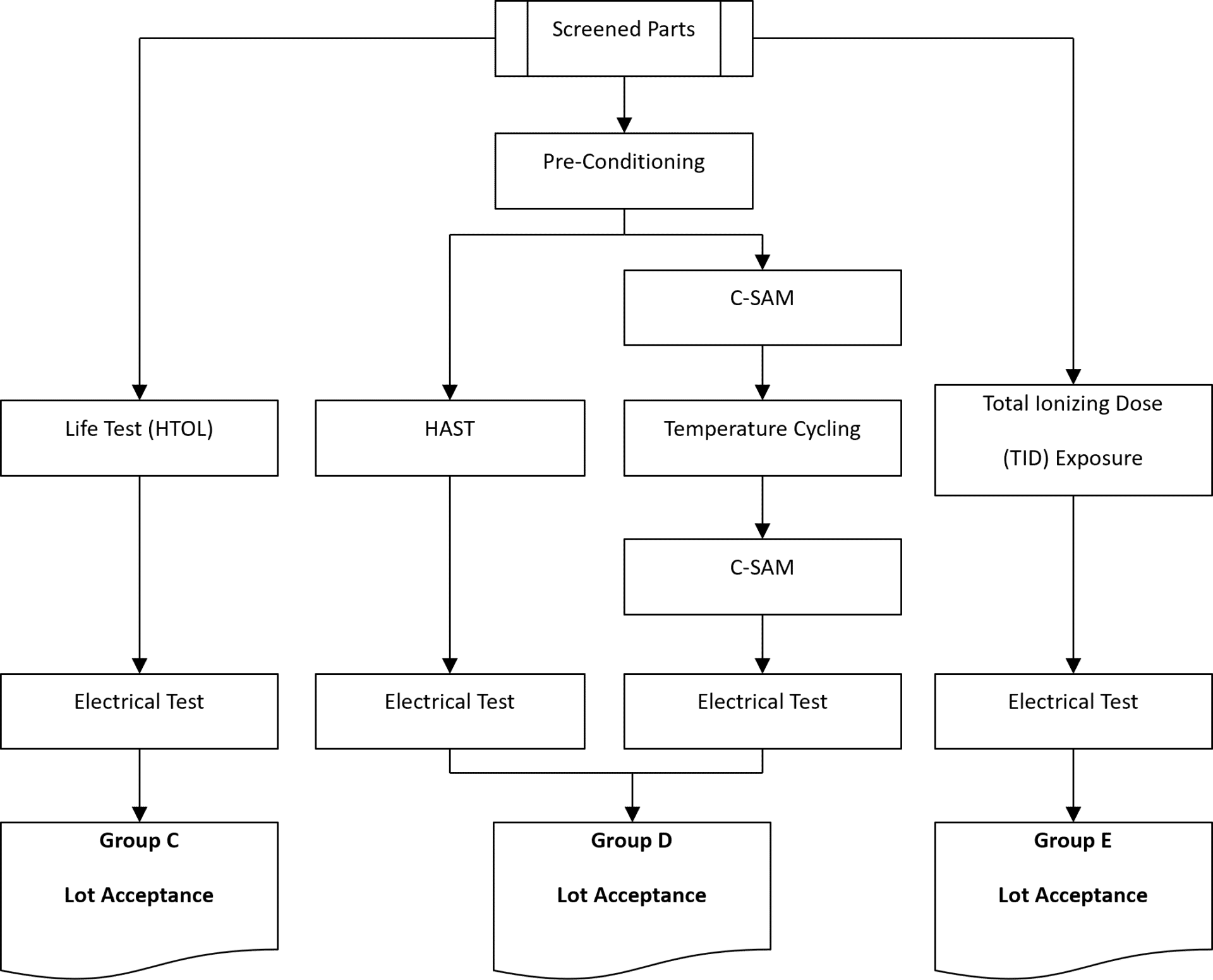
Apogee Semiconductor offers its products in four production grades: A-Grade, B-Grade, C-Grade, and E-Grade (Evaluation). Each grade follows a defined production, screening, and lot acceptance flow, summarized below.
Production Flows
| A-Grade | B-Grade | C-Grade | E-Grade | |
| Packaging | Plastic | Plastic | Plastic | Plastic |
| Bond Wires | Au | Au | Au | Au |
| Is Pure Tin (Sn) used? | No | No | No | No |
| Production Burn-in | Yes | No | No | No |
| Operating Temperature Range | -55°C to 125°C | -55°C to 125°C | -55°C to 125°C | -55°C to 125°C (Note 1) |
| Tested Temperatures | -55°C, 25°C, 125°C | -55°C, 25°C, 125°C | 25°C | 25°C |
| Radiation (TID) Lot Acceptance (RLAT) | Yes | Yes | Yes | Note 1 |
| Outgassing Tested per ASTM E595 | Yes | Yes | Yes | Note 1 |
| Lot Level Temp Cycle | Yes | Yes | Yes | Note 1 |
| Lot Level HAST | Yes | Yes | Yes | Note 1 |
| Life Test per Wafer Lot (HTOL) | Yes | Yes | Yes | Note 1 |
| Multiple Wafer Lots per Reel Possible | No | No | No | Yes |
Note 1: Evaluation Grade parts are intended for engineering evaluation only. These units are not suitable for qualification, production, radiation testing, or flight use and are not warranted as to performance over temperature, radiation, or operating life. Evaluation grade devices are provided without any radiation hardness guarantees and may not have completed full device qualification.
Note 2: E-Grade devices with an X preceding the date code (YYWW) are not the final version of the product. X-marked products will be sold only when a device is in pre-production status (as indicated by the datasheet). X-marked status will be indicated clearly on the pre-production datasheet in the ordering information table. For more details about a specific product, please contact support@apogeesemi.com.
Inline Screening Flow
Lot Acceptance Flow
MIL-PRF-38535 and EEE-INST-002 Alignment
The tables below outline how the inline screening and quality conformance inspection (QCI) flows for Apogee Semiconductor Grade A TSSOP devices align with MIL-PRF-38535 and EEE-INST-002.
Table Key
- A = Aligned
- X = Not aligned
- S = Similar (see comments)
- NA = Not applicable; either not applicable for TSSOP plastic packages or not required for the indicated specification
Inline Screening Alignment Matrix
| MIL-PRF-38535 # | EEE-INST-002 # | Description | MIL Spec Standard | EEE-INST-002 (M4 Level 1) Standard | Apogee QMLP Alignment | Apogee EEE-INST-002 Alignment | Comments |
| 1 | Wafer lot acceptance | QM plan (see H.3.2.1.4) or TM 5007 of MIL-STD-883 | S | NA | Internal QM plan. | ||
| 2 | Nondestructive bond pull (NDBP) test | NA | NA | ||||
| 3 | Internal visual inspection | TM 2010, condition A | S | NA | Sample size and magnification level varies by assembly site. | ||
| 4 | 2 | Temperature cycling | TM 1010, condition B, -55 °C to 125 °C, 15 cycles minimum | S | S | Equivalent condition is also used: TM 1010, condition C, -65 °C to 150 °C, 10 cycles minimum. | |
| 5 | Constant acceleration | NA | NA | ||||
| 6 | 1 | Visual inspection | 100% | Per paragraph 5.3.1 of PEM-INST-001 | NA | A | Optional per MIL-PRF-38535. Units are sampled for visual inspection. |
| 7 | Particle Impact Noise Detection (PIND) test | NA | NA | ||||
| 8 | 1 | Serialization | In accordance with device specification (100%) | Per paragraph 5.3.1 of PEM-INST-001 | A | A | |
| 9 | 5 | Pre burn-in (interim) electrical parameters test | In accordance with device specification | Per device specification, at 25 °C and at min. and max. rated operational temperatures | A | S | 25 °C only. |
| 10 | 9 | Burn-in test | TM 1015, 240 hours at 125 °C, condition D | MIL-STD-883, Method 1015, Cond. D, hours minimum | A | A | |
| 11 | Post burn-in (interim) electrical parameters test | In accordance with device specification | NA | NA | |||
| 12 | 7 | Reverse bias burn-in test (static burn-in) | TM 1015, condition A or C; 144 hours at +125 °C or 72 hours at +150 °C minimum | MIL-STD-883, Method 1015, condition A or B, hours minimum depending on the burn-in temperature | NA | X | |
| 13 | 7a | Post burn-in (interim reverse bias) electrical parameters test | In accordance with device specification | NA | NA | ||
| 14 | 11 | Percent defective allowable (PDA) calculation | 5 percent PDA; 3 percent PDA for functional parameters at 25 °C | A | A | ||
| 15 | 10 | Final electrical tests | In accordance with applicable device specification | Per device specification (at 25 °C, maximum, and minimum rated operating temperatures) | A | A | |
| 16 | Seal test | NA | NA | ||||
| 17 | 3 | Radiographic (X-ray) and/or acoustic microscopy test | X-ray: TM 2012 | Per paragraph 5.3.2 of PEM-INST-001 | A | A | |
| 18 | 12 | External visual inspection | TM 2009 | Per paragraph 5.3.1 and Section 8 of PEM-INST-001 | S | A | Units are sampled for visual inspection. |
| 4 | C-SAM inspection | Per paragraph 5.3.3 of PEM-INST-001 | NA | X | |||
| 6 | Engineering review (Steps 1 to 5) | NA | X | ||||
| Destructive Physical Analysis (DPA) | 5 samples per Section 5 of PEM-INST-001 | NA | X |
Quality Conformance Inspection (QCI) Alignment Matrix
| MIL-PRF-38535 Group | EEE-INST-002 # | Description | MIL Spec Standard | EEE-INST-002 (M4 Level 1) Standard | Apogee QMLP Alignment | Apogee EEE-INST-002 Alignment | Comments |
| Group A 1-11 | Final test QA resample | 116(0) or 100 percent / 0 sample | X | NA | |||
| Group B1 | Resistance to solvents | TM 2015 | NA | NA | |||
| Group B2a | Bond strength | TM 2011 | X | NA | Controlled by assembly site SPCs. | ||
| Group B2b | Die shear test or substrate attach strength or stud pull test including passive elements | TM 2019 or TM 2027 | X | NA | Controlled by assembly site SPCs. | ||
| Group B3 | Solderability | TM 2003, solder temperature +245 °C ±5 °C | X | NA | Tested once during device qualification. | ||
| Group B4a | Ball shear test for BGA package | JESD22-B117 | NA | NA | |||
| Group B4b | Solder column pull test for CGA package | TM 2038 | NA | NA | |||
| Group C1a | 6 | Steady-state life test | TM 1005, 45(0), 1000 hours at 125 °C | MIL-STD-883, Method 1005, Cond. D, hours minimum | A | S | 45 samples for 1000 hours at 125 °C. |
| Group C1b | 6 | End-point electrical parameters | As specified in the applicable device procurement specification | Measure at 25 °C, min. and max. rated temperatures | A | A | |
| Group D1 | Physical dimensions | TM 2016 | X | NA | Leads are preformed, which is considered an acceptable substitute per TM 2004 condition B2. | ||
| Group D2a | Lead/terminal integrity test | TM 2004 condition B2 (lead fatigue) or applicable for the package technology style | X | NA | Leads are preformed, which is considered an acceptable substitute per TM 2004 condition B2. | ||
| Group D2b | Seal test | NA | NA | ||||
| Group D2c | BGA/CGA ball/column shear/pull test | NA | NA | ||||
| Group D3a | Thermal shock | NA | NA | ||||
| Group D3b | 4 and 5 | Preconditioning required | JESD22-A113 | JESD22-A113-B, para. 3.1.5, condition A (168 hours, +85 °C, 60% RH) | A | A | Post-stress testing is done at 25 °C only. |
| Group D3b | 3 | Temperature cycling – C-SAM pre | Section 5, paragraph 5.3.1 of PEM-INST-001 | A | A | ||
| Group D3b | 6a | Temperature cycling | TM 1010, condition B (150 cycles min.) | MIL-STD-883, Method 1010, Cond. B (-55 °C to +125 °C), cycles minimum | A | A | |
| Group D3b | 6a | Temperature cycling – C-SAM post | Section 5, paragraph 5.3.3 of PEM-INST-001 | A | A | ||
| Group D3c | 5 | Preconditioning required | JESD22-A113 | JESD22-A113-B, para. 3.1.5, condition A (168 hours, +85 °C, 60% RH) | A | A | |
| Group D3c | 7 | Moisture resistance | JESD22-A118 Unbiased HAST Condition B and/or JESD22-A110 Biased HAST Condition B | A | A | ||
| Group D3d | Visual examination | In accordance with visual criteria of TM 1004 or TM 1010 | A | NA | Inspected per JESD22-B101D. | ||
| Group D3e | Seal test | NA | NA | ||||
| Group D3f | 6a | End-point electrical parameters | As specified in applicable device specification | Measure at 25 °C, min. and max. rated temperatures | A | A | |
| Group D4 | Mechanical shock and vibration | NA | NA | ||||
| Group D5a | Salt atmosphere | TM 1009, test condition A minimum | X | NA | |||
| Group D5b | Visual examination | In accordance with visual criteria of TM 1009 | X | NA | |||
| Group D5c | Seal test | NA | NA | ||||
| Group D6 | Internal gas | NA | NA | ||||
| Group D7 | Adhesion of lead finish | Where applicable, TM 2025 | X | NA | |||
| Group D8 | Lid torque | Where applicable, TM 2024 | NA | NA | |||
| Group D9 | Soldering heat, fine leak, gross leak, visual inspection, and end-point electrical testing | NA | NA | ||||
| Group E1a | Neutron irradiation test (initial qualification test or QCI/TCI test) | TM 1017 at 25 °C | X | NA | NDD testing is ongoing for existing and new products. | ||
| Group E1b | Endpoint electrical parameters test | As specified in the applicable device procurement specification | X | NA | NDD testing is ongoing for existing and new products. | ||
| Group E2a | 2 | Total ionizing dose (TID) test (initial qualification test or QCI/TCI test) | TM 1019 at 25 °C, maximum supply voltage | A | A | ||
| Group E2b | 2 | Endpoint electrical parameters test | As specified in the applicable device procurement specification | A | A | ||
| Group E3a | 2 | Dose rate upset test (transient irradiation test) | Digital: TM 1021; Linear: TM 1023 (temperature at 25 °C) | X | X | ||
| Group E3b | 2 | Endpoint electrical parameters test | As specified in the applicable device procurement specification | X | X | ||
| Group E4 | 2 | Radiation dose rate induced latch-up test | TM 1020 | X | X | ||
| Group E5 | 2 | Single event effects (SEE) test | ASTM F1192 or JESD57 | A | A | SEE testing is done for technology characterization and qualification and is not performed at the lot level. Go to apogeesemi.com for detailed SEE reports. | |
| 1 | Visual inspection and serialization | Section 5, paragraph 5.3.1 of PEM-INST-001 | NA | A | 100% visual inspection and serialization is completed inline. |
Product Change Notification
After a product releases to market, Apogee emphasizes continual improvement strategies, and as a result, we may need to modify, update or discontinue the product or manufacturing process.
Apogee complies with the requirements for timely notification in J-STD-046. Consistent with this industry standard, customers will be notified of major changes which affect the form, fit or function, or adversely affect quality or reliability of the product.
Apogee provides the following information before implementing any notifiable change:
- Detailed description
- Reason for change
- PCN tracking number
- Product identification (affected products)
- Apogee contact information
- Anticipated (positive/negative) impact on fit, form, function, quality & reliability
- Qualification plan and results (or qual schedule if results are not available)
- Sample availability date
- Projected production shipment date
For notification of product changes on automotive devices, Apogee complies with AEC-Q100 Revision H.
Additional information on the PCN process is provided in Apogee’s General Quality Guidelines.
Semiconductor product withdrawal/discontinuance (obsolescence)
Apogee’s product withdrawal/discontinuance process complies with J-STD-048. Our company makes an effort to not obsolete products out of convenience. In addition, our standard obsolescence withdrawal schedule provides a longer lead time than the industry standard. Our schedule allows 12 months for the last order and an additional six months to take final delivery of obsolete products. In rare circumstances, an accelerated withdrawal schedule may be necessary. In such cases, we will communicate to affected customers the last time buy and final delivery dates.
Product obsolescence notifications include:
- Detailed description
- PCN tracking number
- Apogee contact information
- Last order date (no more than 12 months after notification)
- Last delivery date (up to six months after order period ends)
- Product identification (affected products)
- Identification of replacement product, if applicable
Apogee Semiconductor issues Product Change Notifications (PCNs) to inform customers of changes that may affect the form, fit, function, reliability, or quality of our products. Our PCN process follows JEDEC J-STD-046.
PCNs are distributed via email to registered customers. To register or request PCN history for a specific product, contact quality@apogeesemiconductor.com.
Anti-counterfeit
Apogee is committed to delivering high-quality and reliable semiconductor solutions. To help mitigate the risk of counterfeit products, Apogee strongly encourages its customers to purchase all Apogee semiconductor products through Apogee’s authorized sources: either directly from Apogee or through a Apogee-authorized distributor.
Many counterfeits have markings and labels that resemble those on authentic Apogee products, leading customers to believe that they are genuine. Counterfeit products are not manufactured, packaged, labelled, stored or shipped according to Apogee’s standards, however, and they pose considerable performance, safety and reliability risks.
Semiconductor products purchased outside of Apogee’s authorized sources – including through brokers, independent distributors or online marketplaces (sometimes referred to as the “gray market”) – may be counterfeit or unreliable. Additionally, Apogee does not provide warranty coverage or customer support for semiconductor products purchased outside of its authorized sources.
Apogee works actively with the Semiconductor Industry Association and other organizations to combat counterfeiting, advance industry standards that help reduce the incidence of counterfeits, and assist law enforcement agencies in their efforts to address this challenge.
Anti-Counterfeit Policy
Apogee Semiconductor is committed to preventing the introduction of counterfeit components into the supply chain, in accordance with JEDEC JESD243A and AS5553.
Authorized channels
The only authorized sources for Apogee Semiconductor products are:
- Direct purchase from Apogee Semiconductor
- Authorized distributors as listed at apogeesemi.com/distributors
Apogee Semiconductor cannot guarantee the authenticity of products purchased outside of these channels.
How we protect the supply chain
- Authorized distributor program — Distribution agreements define the scope of each distributor's authorization.
Certificate of conformance — Included with every shipment. - Product traceability — Device marking and shipping records support full traceability of all Apogee Semiconductor products.
- Product validation — Customers who need to verify the authenticity of an Apogee Semiconductor component may submit a product validation request by contacting quality@apogeesemiconductor.com.
Reporting suspect counterfeit parts
If you believe you have received a suspect counterfeit Apogee Semiconductor component, please contact us immediately at quality@apogeesemiconductor.com.
Supplier Requirements
All external providers conducting business with Apogee Semiconductor are required to comply with the following requirements. By accepting a purchase order from Apogee Semiconductor, suppliers acknowledge and agree to these terms.
Quality & Compliance Requirements
- Maintain a quality management system appropriate to the products and services provided. Where required by Apogee or its customers, suppliers may be required to use customer-designated or approved external providers or process sources.
- Notify Apogee Semiconductor promptly of any nonconforming processes, products, or services and obtain written approval prior to disposition.
- Take all necessary measures to prevent the use, procurement, or delivery of counterfeit parts.
- Notify Apogee Semiconductor of any changes to processes, products, or services, including changes to your own supply chain or location of manufacture, and obtain Apogee's approval prior to implementation.
- Flow down all applicable Apogee and customer requirements to your own sub-tier suppliers.
- Provide test specimens upon request for design approval, inspection, verification, investigation, or auditing purposes.
- Retain all relevant documented information, including records, for a minimum of 10 years. Upon expiration of the retention period, contact Apogee Semiconductor for disposition instructions.
Right of Access
Apogee Semiconductor, its customers, and applicable regulatory authorities reserve the right of access to all relevant facilities, processes, and documented information at any level of the supply chain.
Defense Priorities and Allocations System (DPAS) Apogee
Semiconductor's products may be used in programs subject to the Defense Priorities and Allocations System (DPAS). Purchase orders issued by Apogee Semiconductor may carry a DPAS priority rating. Suppliers are required to accept and give preferential treatment to DPAS-rated orders and to flow down the applicable priority rating to their own sub-tier suppliers in accordance with DPAS regulations.
Personnel Awareness
Suppliers shall ensure that personnel involved in work for Apogee Semiconductor are aware of:
- Their contribution to product and service conformity — the work performed by supplier personnel directly impacts the quality and reliability of products delivered to Apogee's aerospace and defense customers.
- Their contribution to product safety — errors or nonconformances at the supplier level can result in safety-critical failures in end-use applications.
- The importance of ethical behavior — suppliers are expected to conduct business with integrity, report concerns transparently, and avoid practices such as counterfeit part substitution or falsification of records.
Certifications & Standards
To see our ISO certification, please click on the badge
Click here to download our Quality Document Package (.ZIP)
The following documents are included in the download above as a bundle, but are also available for individual download below:
- Product Grades and Quality Flows
- A-Grade Comparison (MIL-PRF, EEE-INST)
- AS9100 Certification
- RoHS Declaration
- REACH Declaration
- Conflict Minerals Policy
Quality Policies & Procedures
PRODUCT SHELF LIFE
The product shelf life for semiconductor products after delivery to a customer is based on factors such as the type of materials used in the device, manufacturing conditions, moisture sensitivity level (MSL), the use of moisture barrier bags (MBBs) in product packaging, the amount of desiccant used and the customer’s storage conditions. Apoge carefully controls its internal manufacturing and storage processes to deliver products with appropriate customer shelf life performance.
Apogee product storage
We encourage customers to take these details into account when managing and assessing Apogee product storage and life span.
The minimum useful life of a Apogee product is based on the date of delivery to the customer, not the manufacturing date.
Apogee conducts extensive, long-term reliability studies to confirm its internal manufacturing shelf life policy. The studies “Shelf-Life Evaluation of Lead-Free Component Finishes,” “Component Reliability After Long Term Storage”, “BGA Package Component Reliability After Long-Term Storage” and “Long Term Storage Evaluation of Semiconductor Devices” confirmed that there is no degradation of a product’s electrical characteristics and no product failures associated with TI’s internal manufacturing storage practices. Additionally, Apogee takes specific actions in its product distribution centers to ensure the integrity of all material before shipment.
Because of advancements in technology, materials, manufacturing methods and logistics, Apogee’s manufacturing date code has no impact on usage, quality or reliability of products.
In summary, the minimum useful life of a Apogee product and the Apogee warranty period begins following the delivery of the product to the customer. For more information, refer to our terms of sale.
Customer product shelf life
How customers store Apogee products is critical. Customer product shelf life refers to the length of time that a customer can properly store a product after delivery. The way that our customers store and handle Apogee products is critical to ensuring that the products meet their expected customer shelf life. Please see the MSL information on Apogee product bags or boxes for instructions regarding the acceptable length of environmental exposure. Note that certain products are moisture-sensitive and therefore require packing in MBBs. We use dedicated MBBs and a defined quantity of desiccant that allows storage within this MBB. Apogee also includes humidity indicator cards (HIC) within its MBBs to ensure that product storage has not been compromised. If the HIC shows pink on >10% level, then the parts in that MBB will need baking before use.
Apogee’s policies and practices help ensure quality, reliability, and continuity of supply. Building, managing and holding inventory in a way that helps ensure continuity of supply to customers provides more immediate availability of products and helps minimize burdens caused by production constraints and end-of-life complications on mature products. Apogee’s policies help ensure continuity of supply. We build, manage and hold inventory in a way that helps ensure continuity of supply to customers. This provides more immediate availability of products, and helps minimize burdens caused by production constraints and end-of-life complications on mature products.
Product Shelf Life and Moisture Sensitivity
Apogee Semiconductor is committed to delivering components that meet the highest standards of reliability and manufacturability. This page outlines our product shelf life policies and moisture sensitivity level (MSL) classifications, in accordance with JEDEC standards.
Moisture Sensitivity Level (MSL) Classification
Apogee Semiconductor characterizes its products for moisture sensitivity in accordance with JEDEC J-STD-020, the industry-standard specification for moisture/reflow sensitivity classification of nonhermetic solid-state surface mount devices.
MSL characterization is performed empirically — each product family undergoes controlled moisture soak and reflow stress testing to determine its classification.
MSL Ratings Table
| MSL Level | Floor Life (at ≤30°C / 60% RH) | Notes |
| MSL 1 | Unlimited | No dry pack required |
| MSL 2 | 1 year | – |
| MSL 2a | 4 weeks | – |
| MSL 3 | 168 hours | – |
| MSL 4 | 72 hours | – |
| MSL 5 | 48 hours | – |
| MSL 5a | 24 hours | – |
| MSL 6 | TOL (Time on Label | Mandatory dry pack |
Note: The majority of Apogee Semiconductor products are currently characterized at MSL 1, meaning they carry an unlimited floor life under standard ambient conditions and require no special dry pack or moisture barrier bag (MBB) packaging.
Product Change Notification
After a product releases to market, Apogee emphasizes continual improvement strategies, and as a result, we may need to modify, update or discontinue the product or manufacturing process.
Apogee complies with the requirements for timely notification in J-STD-046. Consistent with this industry standard, customers will be notified of major changes which affect the form, fit or function, or adversely affect quality or reliability of the product.
Apogee provides the following information before implementing any notifiable change:
- Detailed description
- Reason for change
- PCN tracking number
- Product identification (affected products)
- Apogee contact information
- Anticipated (positive/negative) impact on fit, form, function, quality & reliability
- Qualification plan and results (or qual schedule if results are not available)
- Sample availability date
- Projected production shipment date
For notification of product changes on automotive devices, Apogee complies with AEC-Q100 Revision H.
Additional information on the PCN process is provided in Apogee’s General Quality Guidelines.
Semiconductor product withdrawal/discontinuance (obsolescence)
Apogee’s product withdrawal/discontinuance process complies with J-STD-048. Our company makes an effort to not obsolete products out of convenience. In addition, our standard obsolescence withdrawal schedule provides a longer lead time than the industry standard. Our schedule allows 12 months for the last order and an additional six months to take final delivery of obsolete products. In rare circumstances, an accelerated withdrawal schedule may be necessary. In such cases, we will communicate to affected customers the last time buy and final delivery dates.
Product obsolescence notifications include:
- Detailed description
- PCN tracking number
- Apogee contact information
- Last order date (no more than 12 months after notification)
- Last delivery date (up to six months after order period ends)
- Product identification (affected products)
- Identification of replacement product, if applicable
Apogee Semiconductor issues Product Change Notifications (PCNs) to inform customers of changes that may affect the form, fit, function, reliability, or quality of our products. Our PCN process follows JEDEC J-STD-046.
PCNs are distributed via email to registered customers. To register or request PCN history for a specific product, contact quality@apogeesemiconductor.com.
Anti-counterfeit
Apogee is committed to delivering high-quality and reliable semiconductor solutions. To help mitigate the risk of counterfeit products, Apogee strongly encourages its customers to purchase all Apogee semiconductor products through Apogee’s authorized sources: either directly from Apogee or through a Apogee-authorized distributor.
Many counterfeits have markings and labels that resemble those on authentic Apogee products, leading customers to believe that they are genuine. Counterfeit products are not manufactured, packaged, labelled, stored or shipped according to Apogee’s standards, however, and they pose considerable performance, safety and reliability risks.
Semiconductor products purchased outside of Apogee’s authorized sources – including through brokers, independent distributors or online marketplaces (sometimes referred to as the “gray market”) – may be counterfeit or unreliable. Additionally, Apogee does not provide warranty coverage or customer support for semiconductor products purchased outside of its authorized sources.
Apogee works actively with the Semiconductor Industry Association and other organizations to combat counterfeiting, advance industry standards that help reduce the incidence of counterfeits, and assist law enforcement agencies in their efforts to address this challenge.
Anti-Counterfeit Policy
Apogee Semiconductor is committed to preventing the introduction of counterfeit components into the supply chain, in accordance with JEDEC JESD243A and AS5553.
Authorized channels
The only authorized sources for Apogee Semiconductor products are:
- Direct purchase from Apogee Semiconductor
- Authorized distributors as listed at apogeesemi.com/distributors
Apogee Semiconductor cannot guarantee the authenticity of products purchased outside of these channels.
How we protect the supply chain
- Authorized distributor program — Distribution agreements define the scope of each distributor’s authorization.
Certificate of conformance — Included with every shipment. - Product traceability — Device marking and shipping records support full traceability of all Apogee Semiconductor products.
- Product validation — Customers who need to verify the authenticity of an Apogee Semiconductor component may submit a product validation request by contacting quality@apogeesemiconductor.com.
Reporting suspect counterfeit parts
If you believe you have received a suspect counterfeit Apogee Semiconductor component, please contact us immediately at quality@apogeesemiconductor.com.
Supplier Requirements
SUPPLIER REQUIREMENTS
All external providers conducting business with Apogee Semiconductor are required to comply with the following requirements. By accepting a purchase order from Apogee Semiconductor, suppliers acknowledge and agree to these terms.
Quality & Compliance Requirements
- Maintain a quality management system appropriate to the products and services provided. Where required by Apogee or its customers, suppliers may be required to use customer-designated or approved external providers or process sources.
- Notify Apogee Semiconductor promptly of any nonconforming processes, products, or services and obtain written approval prior to disposition.
- Take all necessary measures to prevent the use, procurement, or delivery of counterfeit parts.
- Notify Apogee Semiconductor of any changes to processes, products, or services, including changes to your own supply chain or location of manufacture, and obtain Apogee’s approval prior to implementation.
- Flow down all applicable Apogee and customer requirements to your own sub-tier suppliers.
- Provide test specimens upon request for design approval, inspection, verification, investigation, or auditing purposes.
- Retain all relevant documented information, including records, for a minimum of 10 years. Upon expiration of the retention period, contact Apogee Semiconductor for disposition instructions.
Right of Access
Apogee Semiconductor, its customers, and applicable regulatory authorities reserve the right of access to all relevant facilities, processes, and documented information at any level of the supply chain.
Defense Priorities and Allocations System (DPAS) Apogee
Semiconductor’s products may be used in programs subject to the Defense Priorities and Allocations System (DPAS). Purchase orders issued by Apogee Semiconductor may carry a DPAS priority rating. Suppliers are required to accept and give preferential treatment to DPAS-rated orders and to flow down the applicable priority rating to their own sub-tier suppliers in accordance with DPAS regulations.
Personnel Awareness
Suppliers shall ensure that personnel involved in work for Apogee Semiconductor are aware of:
- Their contribution to product and service conformity — the work performed by supplier personnel directly impacts the quality and reliability of products delivered to Apogee’s aerospace and defense customers.
- Their contribution to product safety — errors or nonconformances at the supplier level can result in safety-critical failures in end-use applications.
- The importance of ethical behavior — suppliers are expected to conduct business with integrity, report concerns transparently, and avoid practices such as counterfeit part substitution or falsification of records.
Certifications & Standards
To see the ISO certification please click on the badge

Terms of Sale v1-15/10/2026