


Quality
At Apogee Semiconductor, quality is engineered into every stage of development, from architecture and design through manufacturing and long-term product support.
key pillars of Apogee’s quality approach

Design & Change Control
Structured design reviews, verification planning, and formal change control processes ensure product integrity from concept through production.
Manufacturing & Supplier Oversight
Apogee works with qualified foundry, assembly, and test partners and maintains oversight through documented processes, traceability, and supplier performance monitoring.
Reliability & Qualification
Products are evaluated through defined qualification flows and reliability assessment to support robust operation across expected environmental and electrical conditions.
Continuous Improvement
Quality metrics, corrective action processes, and engineering feedback loops enable continuous improvement in both design and manufacturing processes.
Quality / Quality
Product grades and quality flows
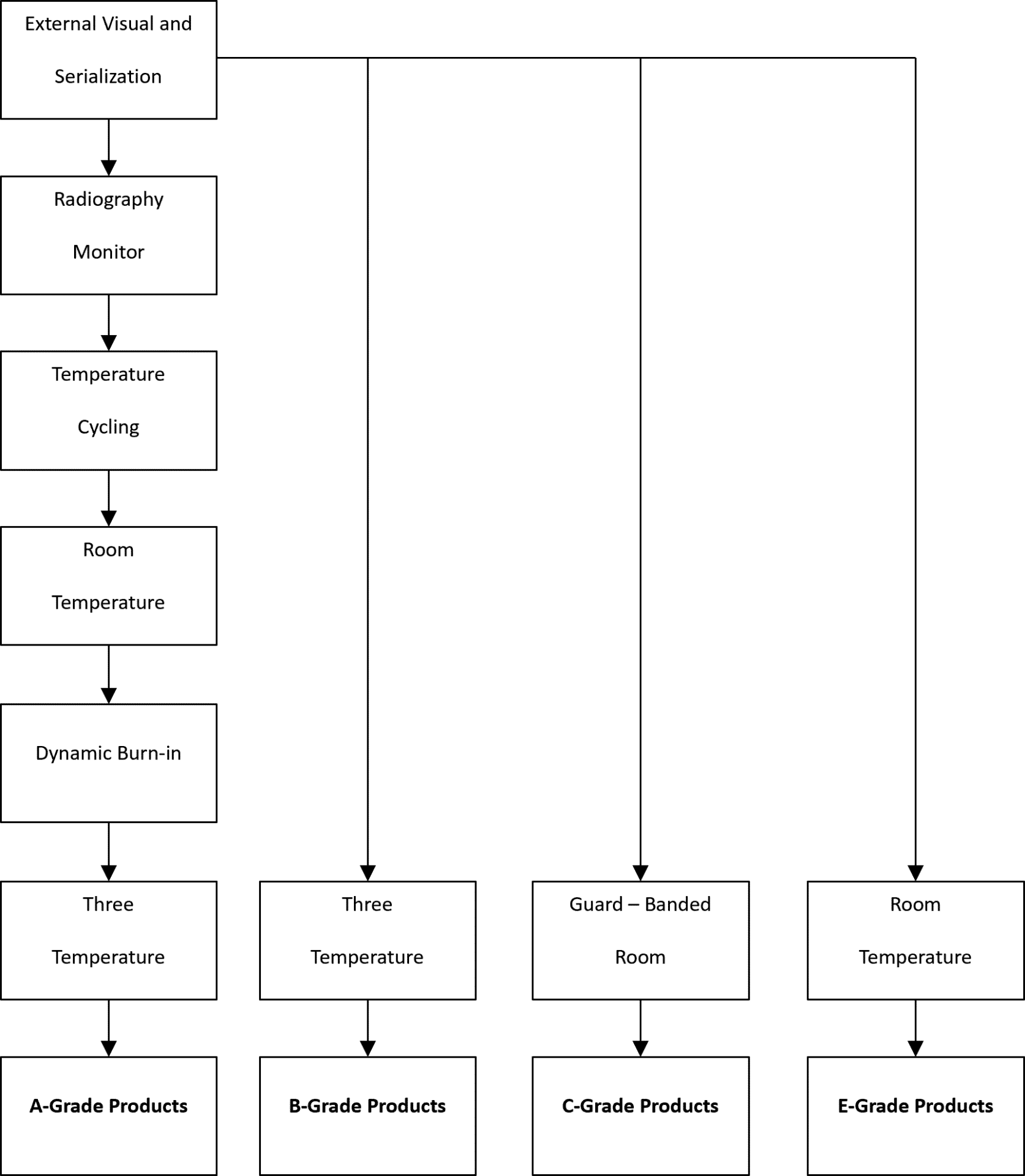
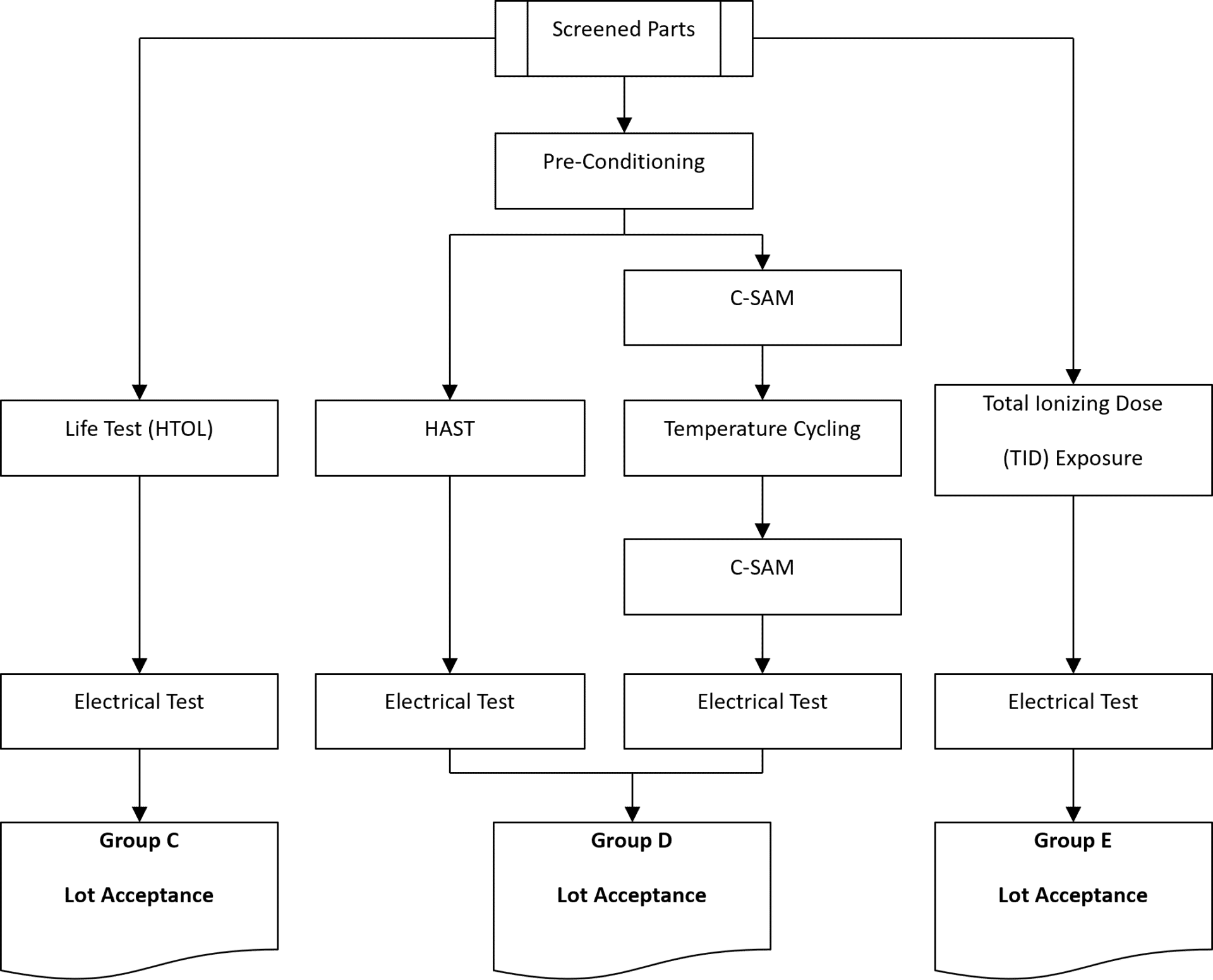
Apogee Semiconductor offers its products in four production grades: A-Grade, B-Grade, C-Grade, and E-Grade (Evaluation). Each grade follows a defined production, screening, and lot acceptance flow.
Production flows
| A-Grade | B-Grade | C-Grade | E-Grade | |
|---|---|---|---|---|
| Packaging | Plastic | Plastic | Plastic | Plastic |
| Bond wires | Au | Au | Au | Au |
| Pure tin (Sn) used | No | No | No | No |
| Production burn-in | Yes | No | No | No |
| Operating temperature range | -55 °C to 125 °C | -55 °C to 125 °C | -55 °C to 125 °C | -55 °C to 125 °C (Note 1) |
| Tested temperatures | -55 °C, 25 °C, 125 °C | -55 °C, 25 °C, 125 °C | 25 °C | 25 °C |
| Radiation (TID) lot acceptance (RLAT) | Yes | Yes | Yes | Note 1 |
| Outgassing tested per ASTM E595 | Yes | Yes | Yes | Note 1 |
| Lot-level temperature cycle | Yes | Yes | Yes | Note 1 |
| Lot-level HAST | Yes | Yes | Yes | Note 1 |
| Life test per wafer lot (HTOL) | Yes | Yes | Yes | Note 1 |
| Multiple wafer lots per reel possible | No | No | No | Yes |
Table 1: Apogee Semiconductor production flows
Note 1: Evaluation Grade parts are intended for engineering evaluation only. These units are not suitable for qualification, production, radiation testing, or flight use and are not warranted as to performance over temperature, radiation, or operating life. Evaluation Grade devices are provided without any radiation hardness guarantees and may not have completed full device qualification.
Note 2: E-Grade devices with an X preceding the date code (YYWW) are not the final version of the product. X-marked products are sold only while a device is in pre-production status, as indicated by the datasheet, and X-marked status is shown in the ordering information table of the pre-production datasheet. For details about a specific product, contact support@apogeesemi.com.
Inline screening flow
Lot acceptance flow
Need grade or screening details for a specific part? Contact our quality team.
Quality / Quality
MIL-PRF-38535 and EEE-INST-002 compliance
The matrices below show how the inline screening and quality conformance inspection (QCI) flows for Apogee Semiconductor Grade A TSSOP devices align with MIL-PRF-38535 and EEE-INST-002.
EEE-INST-002 is a specification developed by the National Aeronautics and Space Administration (NASA). Apogee Grade A TSSOP devices most closely align with Section M4 of EEE-INST-002, which covers plastic encapsulated microcircuits (PEMs).
MIL-PRF-38535 is a specification developed by the Defense Logistics Agency (DLA). Apogee Grade A TSSOP devices most closely align with its QML Class P guidelines. Inline screening guidelines are in Table IA of MIL-PRF-38535, and QCI guidelines are in Tables II through V and Table C-I.
Table key
- A
- Aligned
- X
- Not aligned
- S
- Similar (see comments)
- NA
- Not applicable; either not applicable for TSSOP plastic packages or not required for the indicated specification
Inline screening alignment matrix
Table 2: Inline screening alignment matrix
| MIL-PRF-38535 # | EEE-INST-002 # | Description | MIL Spec Standard | EEE-INST-002 (M4 Level 1) Standard | Apogee QMLP Alignment | Apogee EEE-INST-002 Alignment | Comments |
|---|---|---|---|---|---|---|---|
| 1 | Wafer lot acceptance | QM plan (see H.3.2.1.4) or TM 5007 of MIL-STD-883 | S | NA | Internal QM plan. | ||
| 2 | Nondestructive bond pull (NDBP) test | NA | NA | ||||
| 3 | Internal visual inspection | TM 2010, condition A | S | NA | Sample size and magnification level varies by assembly site. | ||
| 4 | 2 | Temperature cycling | TM 1010, condition B, -55 °C to 125 °C, 15 cycles minimum | S | S | Equivalent condition is also used: TM 1010, condition C, -65 °C to 150 °C, 10 cycles minimum. | |
| 5 | Constant acceleration | NA | NA | ||||
| 6 | 1 | Visual inspection | 100% | Per paragraph 5.3.1 of PEM-INST-001 | NA | A | Optional per MIL-PRF-38535. Units are sampled for visual inspection. |
| 7 | Particle Impact Noise Detection (PIND) test | NA | NA | ||||
| 8 | 1 | Serialization | In accordance with device specification (100%) | Per paragraph 5.3.1 of PEM-INST-001 | A | A | |
| 9 | 5 | Pre burn-in (interim) electrical parameters test | In accordance with device specification | Per device specification, at 25 °C and at min. and max. rated operational temperatures | A | S | 25 °C only. |
| 10 | 9 | Burn-in test | TM 1015, 240 hours at 125 °C, condition D | MIL-STD-883, Method 1015, Cond. D, hours minimum | A | A | |
| 11 | Post burn-in (interim) electrical parameters test | In accordance with device specification | NA | NA | |||
| 12 | 7 | Reverse bias burn-in test (static burn-in) | TM 1015, condition A or C; 144 hours at +125 °C or 72 hours at +150 °C minimum | MIL-STD-883, Method 1015, condition A or B, hours minimum depending on the burn-in temperature | NA | X | |
| 13 | 7a | Post burn-in (interim reverse bias) electrical parameters test | In accordance with device specification | NA | NA | ||
| 14 | 11 | Percent defective allowable (PDA) calculation | 5 percent PDA; 3 percent PDA for functional parameters at 25 °C | A | A | ||
| 15 | 10 | Final electrical tests | In accordance with applicable device specification | Per device specification (at 25 °C, maximum, and minimum rated operating temperatures) | A | A | |
| 16 | Seal test | NA | NA | ||||
| 17 | 3 | Radiographic (X-ray) and/or acoustic microscopy test | X-ray: TM 2012 | Per paragraph 5.3.2 of PEM-INST-001 | A | A | |
| 18 | 12 | External visual inspection | TM 2009 | Per paragraph 5.3.1 and Section 8 of PEM-INST-001 | S | A | Units are sampled for visual inspection. |
| 4 | C-SAM inspection | Per paragraph 5.3.3 of PEM-INST-001 | NA | X | |||
| 6 | Engineering review (Steps 1 to 5) | NA | X | ||||
| Destructive Physical Analysis (DPA) | 5 samples per Section 5 of PEM-INST-001 | NA | X |
Quality conformance inspection (QCI) alignment matrix
Table 3: QCI alignment matrix
| MIL-PRF-38535 Group | EEE-INST-002 # | Description | MIL Spec Standard | EEE-INST-002 (M4 Level 1) Standard | Apogee QMLP Alignment | Apogee EEE-INST-002 Alignment | Comments |
|---|---|---|---|---|---|---|---|
| Group A 1-11 | Final test QA resample | 116(0) or 100 percent / 0 sample | X | NA | |||
| Group B1 | Resistance to solvents | TM 2015 | NA | NA | |||
| Group B2a | Bond strength | TM 2011 | X | NA | Controlled by assembly site SPCs. | ||
| Group B2b | Die shear test or substrate attach strength or stud pull test including passive elements | TM 2019 or TM 2027 | X | NA | Controlled by assembly site SPCs. | ||
| Group B3 | Solderability | TM 2003, solder temperature +245 °C ±5 °C | X | NA | Tested once during device qualification. | ||
| Group B4a | Ball shear test for BGA package | JESD22-B117 | NA | NA | |||
| Group B4b | Solder column pull test for CGA package | TM 2038 | NA | NA | |||
| Group C1a | 6 | Steady-state life test | TM 1005, 45(0), 1000 hours at 125 °C | MIL-STD-883, Method 1005, Cond. D, hours minimum | A | S | 45 samples for 1000 hours at 125 °C. |
| Group C1b | 6 | End-point electrical parameters | As specified in the applicable device procurement specification | Measure at 25 °C, min. and max. rated temperatures | A | A | |
| Group D1 | Physical dimensions | TM 2016 | X | NA | Leads are preformed, which is considered an acceptable substitute per TM 2004 condition B2. | ||
| Group D2a | Lead/terminal integrity test | TM 2004 condition B2 (lead fatigue) or applicable for the package technology style | X | NA | Leads are preformed, which is considered an acceptable substitute per TM 2004 condition B2. | ||
| Group D2b | Seal test | NA | NA | ||||
| Group D2c | BGA/CGA ball/column shear/pull test | NA | NA | ||||
| Group D3a | Thermal shock | NA | NA | ||||
| Group D3b | 4 and 5 | Preconditioning required | JESD22-A113 | JESD22-A113-B, para. 3.1.5, condition A (168 hours, +85 °C, 60% RH) | A | A | Post-stress testing is done at 25 °C only. |
| Group D3b | 3 | Temperature cycling – C-SAM pre | Section 5, paragraph 5.3.1 of PEM-INST-001 | A | A | ||
| Group D3b | 6a | Temperature cycling | TM 1010, condition B (150 cycles min.) | MIL-STD-883, Method 1010, Cond. B (-55 °C to +125 °C), cycles minimum | A | A | |
| Group D3b | 6a | Temperature cycling – C-SAM post | Section 5, paragraph 5.3.3 of PEM-INST-001 | A | A | ||
| Group D3c | 5 | Preconditioning required | JESD22-A113 | JESD22-A113-B, para. 3.1.5, condition A (168 hours, +85 °C, 60% RH) | A | A | |
| Group D3c | 7 | Moisture resistance | JESD22-A118 Unbiased HAST Condition B and/or JESD22-A110 Biased HAST Condition B | A | A | ||
| Group D3d | Visual examination | In accordance with visual criteria of TM 1004 or TM 1010 | A | NA | Inspected per JESD22-B101D. | ||
| Group D3e | Seal test | NA | NA | ||||
| Group D3f | 6a | End-point electrical parameters | As specified in applicable device specification | Measure at 25 °C, min. and max. rated temperatures | A | A | |
| Group D4 | Mechanical shock and vibration | NA | NA | ||||
| Group D5a | Salt atmosphere | TM 1009, test condition A minimum | X | NA | |||
| Group D5b | Visual examination | In accordance with visual criteria of TM 1009 | X | NA | |||
| Group D5c | Seal test | NA | NA | ||||
| Group D6 | Internal gas | NA | NA | ||||
| Group D7 | Adhesion of lead finish | Where applicable, TM 2025 | X | NA | |||
| Group D8 | Lid torque | Where applicable, TM 2024 | NA | NA | |||
| Group D9 | Soldering heat, fine leak, gross leak, visual inspection, and end-point electrical testing | NA | NA | ||||
| Group E1a | Neutron irradiation test (initial qualification test or QCI/TCI test) | TM 1017 at 25 °C | X | NA | NDD testing is ongoing for existing and new products. | ||
| Group E1b | Endpoint electrical parameters test | As specified in the applicable device procurement specification | X | NA | NDD testing is ongoing for existing and new products. | ||
| Group E2a | 2 | Total ionizing dose (TID) test (initial qualification test or QCI/TCI test) | TM 1019 at 25 °C, maximum supply voltage | A | A | ||
| Group E2b | 2 | Endpoint electrical parameters test | As specified in the applicable device procurement specification | A | A | ||
| Group E3a | 2 | Dose rate upset test (transient irradiation test) | Digital: TM 1021; Linear: TM 1023 (temperature at 25 °C) | X | X | ||
| Group E3b | 2 | Endpoint electrical parameters test | As specified in the applicable device procurement specification | X | X | ||
| Group E4 | 2 | Radiation dose rate induced latch-up test | TM 1020 | X | X | ||
| Group E5 | 2 | Single event effects (SEE) test | ASTM F1192 or JESD57 | A | A | SEE testing is done for technology characterization and qualification and is not performed at the lot level. Go to apogeesemi.com for detailed SEE reports. | |
| 1 | Visual inspection and serialization | Section 5, paragraph 5.3.1 of PEM-INST-001 | NA | A | 100% visual inspection and serialization is completed inline. |
Need the full alignment document or details for a specific device? Request quality documentation.
Quality / Quality
Product change notification
After a product is released, Apogee continues to improve its products and processes, so we may need to modify or update a product or a manufacturing process. Apogee Semiconductor issues Product Change Notifications (PCNs) so customers are informed before changes that may affect form, fit, function, quality, or reliability.
Change notification process
Apogee’s PCN process follows JEDEC J-STD-046. Customers are notified of major changes that affect the form, fit, or function of a product, or that adversely affect its quality or reliability. Before implementing any notifiable change, Apogee provides:
- A detailed description of the change
- The reason for the change
- A PCN tracking number
- Identification of affected products
- Apogee contact information
- Anticipated positive or negative impact on fit, form, function, quality, and reliability
- The qualification plan and results, or the qualification schedule if results are not yet available
- Sample availability date
- Projected production shipment date
Further details on the PCN process are available in Apogee’s General Quality Guidelines, which you can request from our quality team.
Receiving PCNs
PCNs are distributed by email to registered customers. To register, or to request the PCN history for a specific product, contact quality@apogeesemi.com.
Questions about a specific change? Contact our quality team.
Quality / Quality
Product obsolescence
Apogee’s product withdrawal and discontinuance process complies with JEDEC J-STD-048. We work to avoid discontinuing products for convenience, and our standard withdrawal schedule gives customers more lead time than the industry standard.
Withdrawal schedule
Our standard schedule allows 12 months to place last orders, plus an additional six months to take final delivery. In rare cases an accelerated schedule may be necessary; affected customers will then be told the last-time-buy and final delivery dates.
What obsolescence notifications include
- A detailed description
- A PCN tracking number
- Apogee contact information
- Last order date (no more than 12 months after notification)
- Last delivery date (up to six months after the order period ends)
- Identification of affected products
- Identification of a replacement product, if applicable
Obsolescence notifications are distributed the same way as PCNs. To register, contact quality@apogeesemi.com.
Questions about a discontinued or end-of-life product? Contact our quality team.
Quality / Quality
Anti-counterfeit
Apogee Semiconductor is committed to preventing counterfeit components from entering the supply chain, in accordance with JEDEC JESD243A and SAE AS5553. To reduce the risk of counterfeit parts, we strongly encourage customers to buy Apogee products only from authorized sources: directly from Apogee or from an Apogee-authorized distributor.
Why authorized sources matter
Counterfeit parts often carry markings and labels that closely resemble genuine Apogee products. Because they are not manufactured, packaged, labeled, stored, or shipped to Apogee’s standards, they pose serious performance, safety, and reliability risks.
Products bought outside Apogee’s authorized sources, including from brokers, independent distributors, or online marketplaces, may be counterfeit or unreliable. Apogee does not provide warranty coverage or customer support for products purchased outside its authorized sources, and cannot guarantee their authenticity.
Authorized channels
The only authorized sources for Apogee Semiconductor products are:
- Direct purchase from Apogee Semiconductor
- Authorized distributors listed on our distributors page
How we protect the supply chain
- Authorized distributor program: distribution agreements define the scope of each distributor’s authorization.
- Certificate of conformance: included with every shipment.
- Product traceability: device marking and shipping records support full traceability of all Apogee Semiconductor products.
- Product validation: customers who need to verify the authenticity of an Apogee component can submit a validation request to quality@apogeesemi.com.
Reporting suspect counterfeit parts
If you believe you have received a suspect counterfeit Apogee Semiconductor component, contact us immediately at quality@apogeesemi.com.
Need to verify a part or report a concern? Contact our quality team.
Quality / Certifications and standards
ISO 9001 certificate
Apogee Semiconductor’s quality management system is certified to ISO 9001.
View the ISO 9001 certificate (PDF)
Quality documentation
Our Quality Document Package bundles certificates and quality policy documents for customer qualification and supplier audits.
Download the Quality Document Package (.zip)
Need a document that isn’t listed here? Request quality documentation.
Quality / Reliability
Product shelf life
How long a semiconductor product can be stored after delivery depends on the materials used in the device, manufacturing conditions, its moisture sensitivity level (MSL), whether it ships in a moisture barrier bag (MBB), the amount of desiccant included, and how the customer stores it. Apogee controls its internal manufacturing and storage processes so that products reach customers with appropriate shelf life performance.
Apogee product storage
The minimum useful life of an Apogee product is measured from the date of delivery to the customer, not from the manufacturing date. Apogee’s manufacturing date code has no effect on a product’s usage, quality, or reliability.
Both the minimum useful life of a product and the Apogee warranty period begin when the product is delivered to the customer. For details, see our Terms of Sale.
Customer storage and handling
Customer shelf life is the length of time a customer can properly store a product after delivery, and it depends heavily on storage and handling. The MSL information printed on Apogee bags and boxes states how long parts can be exposed to the environment.
Moisture-sensitive products ship in dedicated MBBs with a defined quantity of desiccant and a humidity indicator card (HIC). If the HIC shows pink at the 10% level or higher, the parts in that bag must be baked before use.
Apogee builds, manages, and holds inventory to support continuity of supply. This makes products more immediately available and reduces the impact of production constraints and end-of-life transitions on mature products.
Questions about storage or handling for a specific product? Contact our quality team.
Quality / Suppliers
Personnel awareness
All external providers conducting business with Apogee Semiconductor are required to comply with Apogee’s supplier requirements. By accepting a purchase order from Apogee Semiconductor, suppliers acknowledge and agree to these terms.
What supplier personnel must be aware of
Suppliers shall ensure that personnel involved in work for Apogee Semiconductor are aware of:
- Their contribution to product and service conformity: the work performed by supplier personnel directly impacts the quality and reliability of products delivered to Apogee’s aerospace and defense customers.
- Their contribution to product safety: errors or nonconformances at the supplier level can result in safety-critical failures in end-use applications.
- The importance of ethical behavior: suppliers are expected to conduct business with integrity, report concerns transparently, and avoid practices such as counterfeit part substitution or falsification of records.
Supplier questions? Contact Apogee Semiconductor.
Quality / Environmental information
RoHS declaration
Apogee Semiconductor provides environmental compliance information for its products to support customers’ material declarations and regulatory reporting.
RoHS compliance
TO FILL IN: Apogee’s RoHS compliance statement, including the directive version it is assessed against and any exemptions that apply.
Download the RoHS declaration (PDF)
Need a material declaration or compliance document for a specific product? Contact our quality team.
Quality / Environmental information
REACH declaration
Apogee Semiconductor provides environmental compliance information for its products to support customers’ material declarations and regulatory reporting.
REACH compliance
TO FILL IN: Apogee’s REACH statement, including whether products contain Substances of Very High Concern (SVHCs) above the reporting threshold and the candidate list date the declaration covers.
Download the REACH declaration (PDF)
Need a material declaration or compliance document for a specific product? Contact our quality team.
Quality / Environmental information
Conflict minerals policy
Apogee Semiconductor provides environmental compliance information for its products to support customers’ material declarations and regulatory reporting.
Conflict minerals
TO FILL IN: Apogee’s conflict minerals policy statement and whether a Conflict Minerals Reporting Template (CMRT) is available on request.
Download the conflict minerals policy (PDF)
Need a material declaration or compliance document for a specific product? Contact our quality team.
Quality / Reliability
Moisture sensitivity level (MSL)
Apogee characterizes its products for moisture sensitivity in accordance with JEDEC J-STD-020, the industry standard for moisture/reflow sensitivity classification of nonhermetic surface mount devices.
How products are classified
Classification is determined empirically: each product family undergoes controlled moisture soak and reflow stress testing to establish its MSL rating.
MSL ratings
| MSL level | Floor life (at ≤30 °C / 60% RH) | Notes |
|---|---|---|
| MSL 1 | Unlimited | No dry pack required |
| MSL 2 | 1 year | – |
| MSL 2a | 4 weeks | – |
| MSL 3 | 168 hours | – |
| MSL 4 | 72 hours | – |
| MSL 5 | 48 hours | – |
| MSL 5a | 24 hours | – |
| MSL 6 | Time on label (TOL) | Mandatory dry pack |
MSL ratings and floor life
Note: Most Apogee Semiconductor products are currently characterized at MSL 1. They have unlimited floor life under standard ambient conditions and do not require dry pack or MBB packaging.
Need the MSL rating for a specific product? Contact our quality team.
Quality / Suppliers
Supplier requirements
All external providers conducting business with Apogee Semiconductor are required to comply with Apogee’s supplier requirements. By accepting a purchase order from Apogee Semiconductor, suppliers acknowledge and agree to these terms.
Quality and compliance requirements
Suppliers shall:
- Maintain a quality management system appropriate to the products and services provided. Where required by Apogee or its customers, suppliers may be required to use customer-designated or approved external providers or process sources.
- Notify Apogee Semiconductor promptly of any nonconforming processes, products, or services and obtain written approval prior to disposition.
- Take all necessary measures to prevent the use, procurement, or delivery of counterfeit parts.
- Notify Apogee Semiconductor of any changes to processes, products, or services, including changes to their own supply chain or location of manufacture, and obtain Apogee’s approval prior to implementation.
- Flow down all applicable Apogee and customer requirements to their own sub-tier suppliers.
- Provide test specimens upon request for design approval, inspection, verification, investigation, or auditing purposes.
- Retain all relevant documented information, including records, for a minimum of 10 years. Upon expiration of the retention period, contact Apogee Semiconductor for disposition instructions.
Supplier questions? Contact Apogee Semiconductor.
Quality / Suppliers
Right of access
All external providers conducting business with Apogee Semiconductor are required to comply with Apogee’s supplier requirements. By accepting a purchase order from Apogee Semiconductor, suppliers acknowledge and agree to these terms.
Access requirements
Apogee Semiconductor, its customers, and applicable regulatory authorities reserve the right of access to all relevant facilities, processes, and documented information at any level of the supply chain.
Supplier questions? Contact Apogee Semiconductor.
Quality / Suppliers
Defense Priorities and Allocations System (DPAS)
All external providers conducting business with Apogee Semiconductor are required to comply with Apogee’s supplier requirements. By accepting a purchase order from Apogee Semiconductor, suppliers acknowledge and agree to these terms.
DPAS-rated orders
Apogee Semiconductor’s products may be used in programs subject to the Defense Priorities and Allocations System (DPAS). Purchase orders issued by Apogee Semiconductor may carry a DPAS priority rating.
Suppliers are required to accept and give preferential treatment to DPAS-rated orders and to flow down the applicable priority rating to their own sub-tier suppliers in accordance with DPAS regulations.
Supplier questions? Contact Apogee Semiconductor.
Terms of Sale v1-15/10/2026